Thursday, March 30, 2017

The 13th-century Motet

Let’s wrap up our month of Medieval music by looking at a very important genre that developed in the early 13th century – the motet.  This type of polyphony adds a newly-written Latin text to the upper voices of clausulae. Wait – what does that mean? “Clausulae” were sections of organum (see my last post!) that could be removed and replaced with a new section. Therefore, a motet contained a new text sung with a lower part that usually was taken from chant. Eventually more voices were added, singing their own individual texts. The motet developed in form over time and was performed both inside and outside of the church. One example of a leading motet composer is Guillaume de Machaut.
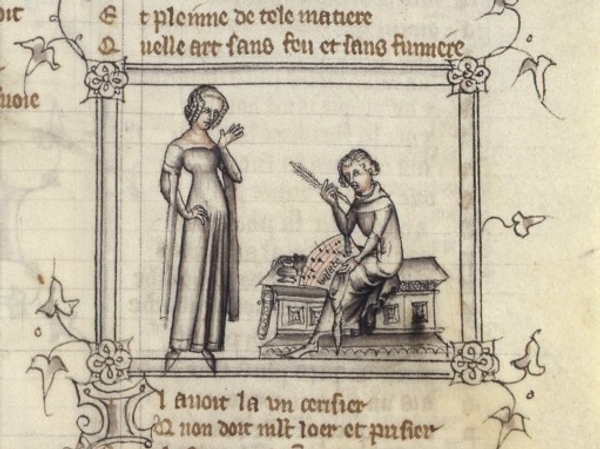
Guillaume de Machaut
Courtesy of wikimedia.org
Around this time, we see more developments in notation including note duration signified by note shapes – quite similar to how we notate music today! Also, we see mensuration signs, the ancestor to modern-day time signatures.

Next month, we’re taking a leap forward in time and hitting our annual music and cinema month in Clef Notes! Join me as we look at our favorite films and how music plays a major part.


Monday, March 27, 2017

An Introduction to Polyphony

This month, Clef Notes has been looking at music from the Medieval era. It’s impossible to cover everything in just one month’s time. Hopefully, however, you have at least been given a good glance at where our Western music tradition finds its roots. This week, let’s wrap up the month by looking at polyphony – music in which multiple voices sing together on independent parts.

Polyphony first rose in significance during the 11th and 12th centuries with the purpose of adding ornamentation to liturgical music. It helped develop the ideas of counterpoint and harmony. It likely existed prior to this point in history, however the earliest written records of this type of music date from this time period. There are various genres of polyphony. We will look at organum today.

Organum consists of a melody sung against a drone or a melody doubled at a consonant interval. It includes two voice parts that follow counterpoint rules. There are various types of organum that we will briefly mention here, but I strongly encourage you to explore more on your own if you find this topic interesting. Parallel organum uses a pre-existing chant in one voice and adds an “organal” voice a fifth below, note for note. Free organum allows the “organal” voice more independence, moving in similar motion (same direction but different interval), contrary motion (opposite direction), or oblique motion (one voice stays the same while the other moves) to the chant voice. Later in the 12th century we see more ornate examples of this type of polyphony, with anywhere from one to three notes in one part to every one note in the original chant voice. Around this time, we see musicians beginning to compose rather that just improvise music, and their system of notation began to indicate duration of notes. It didn’t look quite like music notes do today. They used combinations of note groups rather than note shapes to show the desired duration.

Two important Notre Dame musicians of the time were Leonin and Perotin. These men wrote polyphony, specifically organum. Leonin was known for his collection of two-voice organum, while Perotin also wrote for three or even four voices!


I think that’s probably enough early music for one sitting. Let’s look more at another polyphonic genre next time – the motet!

Thursday, March 23, 2017

Secular Music in the 12th Century

This month, Clef Notes has been looking at music from the Medieval era. So far, we’ve emphasized the importance of the church in relation to the development of music. But did music exist outside of the church? Let’s find out.

Most people outside of the church did not read music during ancient times. In fact, most people were not literate, so much of the music from that time period was never written down. That makes it quite difficult for historians to learn much about the secular music from this time period! We do know that music was seen outside of the church, most commonly as settings of poetry as a means of entertainment.

During the 12th century, we know that many secular, newly-composed works were about unattainable love. There were various types of musicians, depending on the country, who performed music for entertainment purposes. One type was known as a Jongleur. A Jongleur was a lower-class musician who traveled around performing tricks, telling stories, and playing music. A Minstrel is another type of musician seen during the 13th century. A Minstrel was employed by the court as an entertainer. We also know about Troubadours and Trouvereres – poet-composers sponsored by aristocrats in the court. These secular musicians were known by different names depending on the country, but essentially performed the same role.


Troubadour
Courtesy of https://commons.wikimedia.org